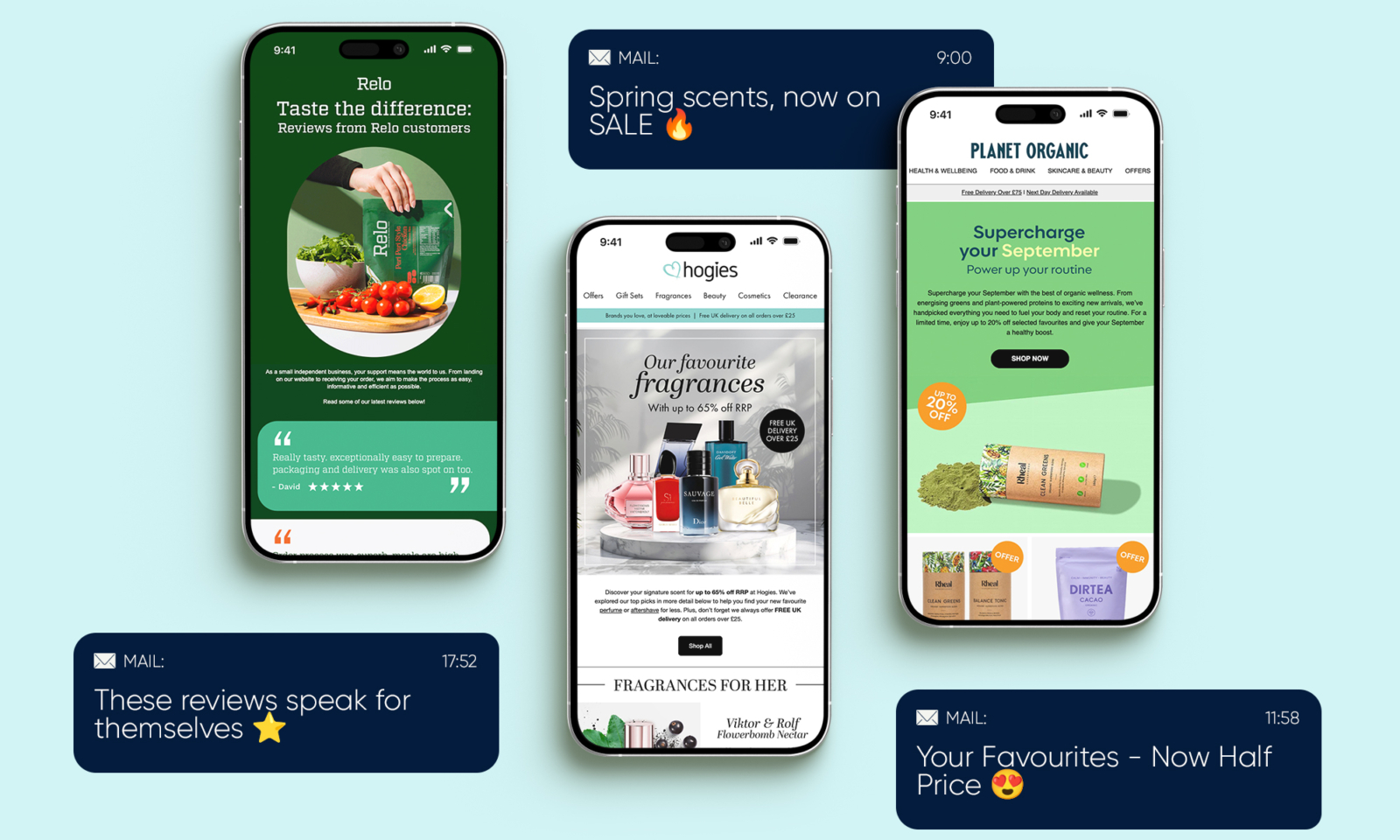
Whether you’re sending out your weekly newsletter or launching a wider campaign, your email strategy can have a big impact on your performance – from open rates and click-through rates to conversions and overall return on investment. In an inbox packed with competing messages and constant offers to try, getting your audience to open, engage with and act on your emails isn’t just about great content; it’s about smart execution.
In this post, we’re stripping back the complexity of email marketing and focusing on quick, actionable ways you can improve your marketing emails to grab user attention from the get-go. From writing subject lines that entice users to open, to ensuring every link earns clicks, we’re here to give you practical tips on how to improve your strategy to see real improvements in your campaigns. Whether you’re new to email marketing or just need a refresher, read on for our favourite ways to better your email strategy.
Are your marketing emails working as hard as they could be?
You’re putting time into your campaigns. You’re crafting the copy, choosing the imagery, building the audience and pressing send. But are your emails actually delivering the results they should be? If low open rates, clicks that don’t convert, and strong offers that fall flat all sound too familiar, your email strategy may not be working as well as it could be.
The truth is, email marketing rarely fails because of one big mistake. More often than not, it’s a handful of small, overlooked details that can limit performance, whether it be a subject line that doesn’t quite land, a call-to-action that blends into the background, or content that isn’t as targeted as it could be. The good news? It’s likely that you don’t need a complete overhaul to see improvements.
Below, we’re breaking down quick, practical ways to sharpen your marketing emails so you can start seeing stronger engagement, better click-through rates and more conversions.
Refine your subject lines
The subject line is the gateway to your entire campaign. It doesn’t matter how strong your design is or how compelling your offer might be; if your subject line doesn’t convince someone to open, the rest of your email simply won’t be seen. In a crowded inbox where you’re competing with dozens of other brands, that first impression carries real weight.
Keep in mind that the majority of emails are being opened on mobile devices, meaning clarity and conciseness are essential. Longer subject lines risk being cut off, which can dilute your message and remove the most impactful part entirely. Keeping the subject line punchy in a way that communicates your message quickly and clearly is the best approach. If a subscriber can’t understand what they’ll gain within a few words, they’re unlikely to open.
With that in mind, concise doesn’t mean bland. Your subject line should still bring curiosity and urgency, creating just enough intrigue to encourage action. The key is to remain authentic to your brand, as overpromising or sounding overly promotional can do more harm than good. Avoid common spam triggers, excessive punctuation, or overly sales-heavy phrases, as these can negatively impact deliverability and push your message straight to the junk folder. A refined, natural tone tends to perform better over time. Get this right again and again, build consistency and eventually, your subscribers will want to open your emails as soon as they see your brand name in their inbox.
Keep it personal
Personalisation in email marketing has evolved well beyond simply adding a first name; it now acknowledges who someone is and what they care about. While adding a name can help an email feel less generic, meaningful personalisation is rooted in relevance to the user. Using behavioural data, purchase history, or browsing patterns can help you create emails that feel intentional rather than mass-distributed.
If a subscriber recently explored a particular product category or abandoned a basket, your follow-up email should reflect that action. When messaging aligns with a user’s demonstrated interest, engagement naturally improves, leading to more conversions.
Focus on value, not just promotion
If every email you send is heavily promotional, engagement will naturally decline over time. Subscribers don’t want to feel like they’re constantly being sold to; they want content that offers value. Emails that include educational insights, practical tips, industry updates or helpful resources can help strengthen the relationship with subscribers and position your brand as a trusted authority.
When subscribers consistently gain something useful from your emails, they’re more likely to stay engaged and respond positively when you do promote a product or service. The balance between value-led content and promotional messaging is what sustains your long-term performance. While short-term sales are important, long-term engagement builds loyalty and repeat conversions.
Make your call-to-action impossible to miss
Every email should have a clear purpose. Whether that’s driving sales, encouraging downloads or increasing sign-ups, your primary goal should shape the entire message with a clear call-to-action. When an email tries to achieve too many things at once, it risks achieving none.
Tips for creating a clear call-to-action:
- Avoid generic phrases that lack direction and urgency, like ‘click here’; instead, focus on benefit-driven copy that tells users exactly what they will gain
- Placement plays a major role in performance – your main CTA should appear above the fold, particularly for mobile users who may not scroll far. Repeating the CTA further down the email can also help to capture readers who engage with the full email
- Focus on design – buttons should be large enough to tap comfortably on mobile devices, and clearly visible against the background. If subscribers have to search for your CTA, this can create friction and reduce conversion rates.
Send at the right time
The timing of your emails can significantly influence performance, but there’s no universal “best time” to send. What works for one audience may not work for another. Testing different days and times is the only reliable way to understand when your subscribers are most receptive to your message. Looking at historical data can also reveal patterns in open rates and click-through behaviour, which can help you refine future sends.
Automation can also improve timing accuracy, so consider real-time action triggers such as welcome sequences, abandoned basket emails and behaviour-triggered campaigns, as these can often outperform scheduled newsletters.
Remember to always test your emails before you send them. Even the strongest strategy can be undermined by simple errors, so make sure to check for any broken links, formatting issues or spelling mistakes before sending.
Improve your design and optimise for mobile
Design is key to the success of your emails, and with a large percentage of emails opened on mobile, scannable formatting is a necessity. Key design elements to ensure you include are:
- Short, scannable text – Long paragraphs and dense blocks of text can feel overwhelming, particularly on mobile. Breaking content into shorter sections using bullet points and subheadings will improve readability and encourage scrolling.
- Purposeful imagery – Every visual element should support your message and not just simply fill space. Overuse of decorative images can distract from your core objective.
- Consistent branding – Using the same colours, fonts and tone of voice reinforces recognition and credibility. These design elements should align with your wider brand identity, helping to create a cohesive experience from inbox to website.
- Pay attention to spacing – Buttons and interactive elements within the email should be designed with touch on mobile in mind. Clear, well-sized buttons and good spacing will improve usability and reduce the risk of accidental taps. And don’t underestimate the power of white space. Giving your content room to breathe with good spacing will enhance readability and make your email feel considered rather than cluttered.
- Test before sending every time – Sending out test emails across multiple devices and platforms is a critical step to ensure you’ve curated a seamless user experience with a refined structure and clear messaging.
Don’t overlook the importance of a clear email strategy
While quick wins can improve performance, they’re far more effective when supported by a clear, consistent strategy. Sending emails sporadically or without a defined purpose can often lead to disengagement, lower open rates, and inconsistent results. Having an effective email strategy that delivers the right message to the right audience, at the right time, ensures that every campaign plays a role in the bigger picture. At its core, a strong email strategy should include:
- Clear objectives – Do you want to drive sales? Increase retention? Nurture leads?
- A defined audience – Have a clear understanding of who you’re speaking to and what matters to them
- Consistent scheduling – Build familiarity and trust through regular, well-timed sends
- A clear message – Make sure each email has a focused purpose and avoids mixed signals
- Planned longevity – Think beyond one-off campaigns and consider how emails support your long-term goals
Without these foundations in place, even well-designed emails can struggle to perform. But when a clear strategy and execution work together, you create a more cohesive experience that drives stronger engagement and more meaningful results.
If you’re unsure where to start when it comes to strategy, this is where expert support from a specialist team like Venture Stream can make a real difference.
Make small changes, see big results
Improving your marketing emails doesn’t require a complete overhaul. If you’re looking to improve your email strategy, focus on small, consistent adjustments, implementing one or two changes in your next campaign and monitor the results. However, the most effective email marketing doesn’t just rely on isolated improvements. It’s built on a clear, well-defined strategy that brings everything together – aligning your messaging, timing, and audience to deliver consistent, measurable results.
If you’re looking to improve your email performance but aren’t sure where to start, our team can help. From building a clear strategy to executing high-performing campaigns, we’ll work with you to create emails that don’t just look good but deliver results. Get in touch with our team today so you can start seeing measurable improvements.
