The global beauty industry has always been quick to embrace change. From the latest revolutionary ingredients and product formulas to social media trends and shifting consumer expectations, what people buy and how they discover it can change quickly. In 2026, beauty ecommerce is entering a new phase, with a website alone no longer being enough to drive sales.
Consumers are discovering products through online content creators, social platforms, marketplaces, search engines, and AI tools. They’re comparing prices across channels, looking for evidence that products work, and becoming increasingly selective about where they spend. NIQ found that global beauty ecommerce sales grew by 18% in 2025, significantly outpacing offline growth, with global beauty sales increasing by 10% year-on-year, and ecommerce growing six times faster than in-store sales.
The global beauty market itself remains resilient, and is expected to grow by around 5% annually through 2030, reaching approximately $590 billion. In this blog, we will explore the current trends in this space and discuss the significant opportunities this brings for brands to expand their reach in an ever-changing social climate.
AI is changing how consumers discover beauty
AI has been making waves in beauty ecommerce over the last few years, particularly through personalised product recommendations and virtual consultations, but its impact is now bigger than ever. It is increasingly becoming part of the discovery and consideration process, with consumers asking AI to recommend products for a particular skin concern, compare ingredients, suggest a skincare routine or find similar alternatives at a particular price point. This completely changes the role of search. It’s thought that AI will play a much larger role in ecommerce transactions over the next three to five years.
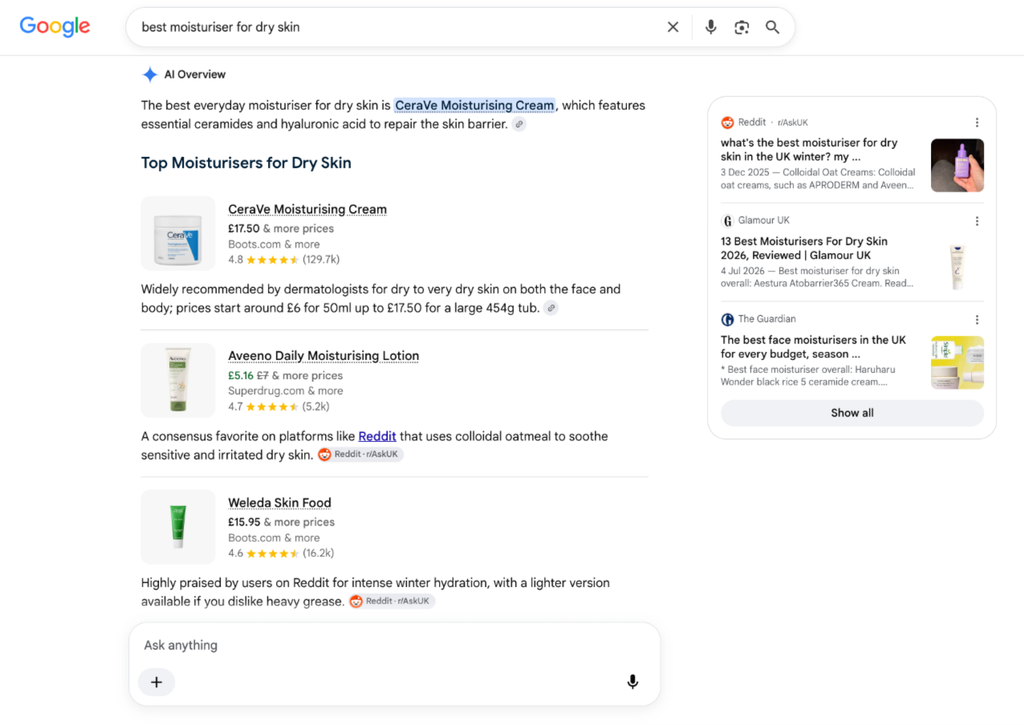
Traditionally, a consumer might search Google for “best moisturiser for dry skin”, browse several websites and decide what to buy. Now, Google searches can also surface AI-generated overviews, giving consumers a concise summary of information and recommendations alongside traditional search results. For beauty brands, this now means their priority should be to make products easy to understand, compare and recommend, whether the customer is using Google, TikTok, a marketplace, or an AI assistant.
Product information needs to be clear, detailed, and structured in a way that both consumers and AI systems can understand, with ingredients, benefits, product suitability, and reviews all becoming important search signals.
Consumers want proof, not just promises
Beauty has always been a category where marketing matters. But consumers are becoming increasingly discerning about what they are actually getting for their money. Recent studies identified a shift towards simpler routines, higher expectations and products that deliver meaningful results. Efficacy, credible ingredients, and multifunctional formats are now influencing which products remain in consumers’ routines. That has implications for brands as it’s no longer enough to describe a product as “luxurious”, “innovative” or “revolutionary”, consumers increasingly want to know:
- What does it actually do?
- Is there evidence that it works?
- What do other customers think?
- Is it worth the price?
Brands need to consider these questions and invest in product content that isn’t simply SEO-focused but content that also directly influences discovery, trust and conversion across multiple channels. Things like reviews, demonstrations, ingredient information, FAQs, before-and-after content and educational product pages can all help answer these questions.
Social commerce is turning discovery into purchase
Social media has long been an important marketing channel for beauty brands. But in 2026, platforms such as TikTok and Instagram are becoming shopping environments in their own right.
Consultancy firm, McKinsey, identifies social commerce as the fastest-growing beauty sales channel, and a report by them shows that in the US, beauty sales on TikTok have grown at triple-digit rates since 2023 and are expected to reach around $4 billion in 2026.
For beauty in particular, using social media as a form of commerce is powerful because products are highly visual and naturally lend themselves to demonstrations, transformations, tutorials and reviews. Live shopping is also creating opportunities for brands to combine entertainment, education and commerce. With consumers using beauty livestreams to discover new products, find promotions, and see products in action, and then go on to purchase during live sessions.
One of the best examples of this is Korean skincare brand Dr. Melaxin. McKinsey reports that the brand grew from zero to a 10% share of the US skincare category on TikTok Shop between 2024 and 2025, generating approximately $57 million in revenue. Its products feature highly visible, immediate effects that lend themselves particularly well to short-form video content.
But brands shouldn’t assume that simply launching on TikTok Shop will guarantee growth.
Social commerce brings additional costs, including creator commissions, promotions and customer acquisition. The brands best positioned to succeed are likely to be those that understand the economics of the channel and create products, content and pricing strategies that work specifically within it.
Global beauty is becoming more local
Beauty ecommerce makes it easier than ever for trends, products and brands to cross borders, with the recent spike in interest in K-beauty being the clearest example. Korean beauty has evolved beyond being a passing trend and is increasingly influencing expectations around formulation, ingredients, skin-first routines and value across international markets. NIQ’s 2026 research describes K-beauty as a global benchmark for efficacy and formulation, and highlights its continued international expansion.
But global expansion isn’t as simple as translating a website and offering shipping internationally; you have to understand how consumer behaviour varies between markets. Economic conditions, cultural preferences, regulations, payment methods, marketplaces, social platforms and expectations around customer service can all influence whether a beauty brand succeeds internationally.
A global trend doesn’t necessarily mean demand will look the same. For example, while K-beauty has gained popularity worldwide, consumers in different markets might be drawn to different products, ingredients, or routines within the wider trend. The channels they use to discover and purchase these products can also vary, meaning that a product that resonates in one country may not have the same impact elsewhere. For beauty brands, understanding these local differences is key to turning global trends into international growth.
NIQ’s Global Beauty Views 2026 research emphasises exactly this. For brands considering international growth, the opportunity is therefore to combine global brand consistency with local relevance. That might mean adapting:
- product ranges
- pricing
- promotional strategies
- payment options
- influencers and creators
- marketplaces
- customer service
- SEO strategies
The brands that understand these local differences will be better positioned to turn international demand into sustainable growth.
Marketplaces, direct-to-consumer, and social are becoming interconnected
The old debate around whether beauty brands should sell through their own website or marketplaces is becoming increasingly irrelevant, with consumers now moving between channels. They might discover a product on TikTok, read reviews on Reddit, compare prices on Google, purchase through Amazon and then return directly to the brand website for their next purchase. The customer doesn’t think in terms of “channels”, they’re simply looking for a convenient purchasing experience.
This blurring of channel boundaries, with digital marketplaces, social commerce, direct-to-consumer websites and physical retail increasingly working alongside one another, means that each channel plays a different role. The opportunity is therefore not to find one “best” channel, but to understand the role each channel plays in the customer journey.
Fenty Beauty offers an interesting example of why brands shouldn’t necessarily view social commerce and DTC as competing channels. TikTok’s analysis of Fenty Beauty found that TikTok Shop generated a 6.7x sales “halo effect” beyond purchases made directly on the platform. Demand generated through TikTok also drove significant traffic and sales to Fenty Beauty’s online store, which captured nearly twice the impact of other halo channels combined. More than a third of incremental sales came from new customers. For brands, this is a useful reminder that the value of a channel shouldn’t always be judged purely on the sales attributed to its own checkout.
Retention matters as much as acquisition
Beauty has a natural advantage when it comes to ecommerce retention, as most products are replenishable. But simply encouraging customers to subscribe isn’t necessarily the answer.
Instead, brands should think more broadly about the relationship they build after the first purchase.
Personalised recommendations, replenishment reminders, loyalty programmes, educational content, product routines, bundles and targeted CRM can all encourage customers to return.
The objective is to move from: ‘How do we get another order?’ to ‘How do we make this customer more valuable over time?’.
This means looking beyond first-order conversion rates and considering metrics such as:
- repeat purchase rate
- customer lifetime value
- contribution margin
- customer acquisition cost
This is especially important as acquisition becomes more competitive. If paid media becomes increasingly expensive and social platforms take a share of sales through commissions and affiliates, retaining existing customers becomes an increasingly important part of profitable growth.
The beauty trends we’re watching in 2026/27
Beyond the bigger shifts happening across ecommerce, there are some standout trends that are worth paying attention to. These emerging trends give us a useful indication of where consumer attention is moving, and where we think there are opportunities for brands to respond.
Beauty and wellness are becoming one and the same
Another global beauty trend we’re witnessing is the blurring of the line between beauty and wellness, with skincare increasingly being talked about alongside sleep, nutrition, fitness and general wellbeing, with consumers looking at their routines more holistically. Consumers are now more concerned about how products can help them maintain healthy skin, support skin barriers, promote anti-aging, or simply create a moment of self-care.
This move towards solutions that combine how people look and how they feel, opens up a much bigger conversation for beauty brands. It’s now more than simply selling a product, it’s about considering how this specific mosituriser can be marketed as a vital part of your wellness routine, or self-care rituals. This means that brands need to think more about the language they use, how they can make their wellness claims credible and how each product can increase customer lifetime value.
The rise of ingredient-led skincare
In recent years, there has been an increase in discourse in the beauty space about specific ingredients in skincare that claim to have a multitude of benefits. The most recent examples being PDRN (a bioactive compound made of DNA fragments traditionally extracted from salmon sperm) and peptides.
PDRN is probably one of the clearest examples of how quickly a beauty ingredient can move from niche to mainstream. It’s typically associated with professional skincare treatments but has increasingly found its way into mainstream skincare, specifically with the rise in K-beauty popularity. It’s hailed for its skin-healing, regenerative, anti-ageing properties which has been “proven” through online content.
This increasing interest in specific ingredients shows that people are now not necessarily just looking for “a good serum”, they’re actively searching for products containing these ingredients they’ve seen across platforms like TikTok and Instagram. For brands this shows that simply putting a trending ingredient on a label isn’t enough – consumers want to understand what an ingredient actually does, how much is in the product and see the credible evidence behind the claims.
Peptides are another major trend focus in skincare right now, particularly in products positioned around skin firmness, hydration, barrier support and anti-ageing. Hailey Bieber’s Rhode brand being one of the most popular, on-trend examples, with a range of peptide-infused skincare and beauty products showing how ingredient education can become a powerful part of beauty branding.
The shift to minimalist packaging
The rise of the “clean girl” aesthetic has brought with it a wave of minimalist packaging in the beauty space, with neutral colour palettes, simple typography and almost clinical branding that is easily recognisable. Brands such as The Ordinary, The Inkey List, and Rhode have made this stripped-back, ingredient-focused approach feel contemporary and desirable to consumers.
Packaging is no longer just something a consumer sees in store, these products might be discovered for the first time in a TikTok “get ready with me” video, an unboxing or an Instagram post. This minimalist packaging approach exudes the affordable and quiet luxury consumers are now looking for in products that can seamlessly fit into their wellness routines and look perfectly curated on their shelf, or in their next Instagram dump.
Our beauty ecommerce predictions for 2027
The trends shaping beauty ecommerce in 2026 have given us a clear indication of where the market is heading, with some of these trends likely to accelerate significantly over the next 12 months. As technology develops and consumers become more comfortable purchasing products through new channels, beauty brands will need to rethink not just how they market products, but how their entire ecommerce operation works.
Here are a few of the predictions we think will shape beauty ecommerce in 2027.
Viral products will have shorter lifecycles
In 2027, we predict that beauty trends will move even faster than they have been. Social commerce has made it easier than ever for a beauty product to go viral, but this also means trends can disappear just as quickly. Brands may need to become better at responding to short-lived demand, from managing stock levels to adapting content and launching products at just the right time in alignment with social trends.
Product launches will become increasingly content-led
A product launch typically involves a new product landing on a website, followed by paid advertising and PR. But as social commerce and the impact of social media continues to grow, the content surrounding a product is now just as important as the product itself. In 2027, we expect brands to put even more time and money into marketing products using content creators, with demonstrations, reviews and creating hype about a product online before it even launches.
Beauty routines will become simpler, but products will need to do more
We have already started to see a shift in beauty trends towards more minimalist routines, and we predict that consumers will continue this desire to simplify their routines, but will become more selective about the products they use. We expect consumers to look for products that can deliver multiple benefits and contain more science-backed ingredients, with visual evidence that a product genuinely works. This means that brands will need to communicate clearly why a product deserves a place in the consumer’s routine within such a saturated market.
The future of beauty ecommerce
Beauty ecommerce is entering a period of significant opportunity, but also increasing complexity. The brands most likely to succeed won’t necessarily be the ones that chase every new trend. They’ll be the ones that understand why consumer behaviour is changing and build flexible ecommerce strategies around it.
The future of beauty ecommerce isn’t about choosing between online and offline, or AI and human expertise, it’s about creating a customer journey that makes it easier for consumers to discover, evaluate, buy and come back. For beauty brands looking to turn trends into sustainable growth, you need a clear ecommerce strategy and a willingness to continually adapt to how customers actually shop.
At Venture Stream, we help health and beauty brands combine ecommerce, marketing, technology and customer insight to create digital experiences designed for growth. From ecommerce strategy and website development to SEO, PPC and retention, discover how our team can help turn changing consumer behaviour into commercial opportunity.
