2024 was a turbulent year for SEO, with many sites still experiencing volatility in their rankings caused by a succession of core updates in the backend of the year.
In recent months, we’ve seen the explosion (and downfall, to an extent) of AI-generated content, and AI become more accessible than ever before thanks to software like ChatGPT and Gemini. We witnessed a huge shift in the Google SERPs as the algorithm strives to reward E-E-A-T (expertise, experience, authority and trust) – but will this continue in 2025?
In this blog, we’ve rounded up thoughts from some of the major players in the SEO space, along with some actionable points to take into your content strategy for the coming year. Here are our top five SEO predictions for 2025.
Prediction #1: traffic erosion & the impact of AI-powered search
In 2025, we can expect to see more AI-powered search features come into the fold as Google continues to push AI into every aspect of its ecosystem, including search, reviews and ads.
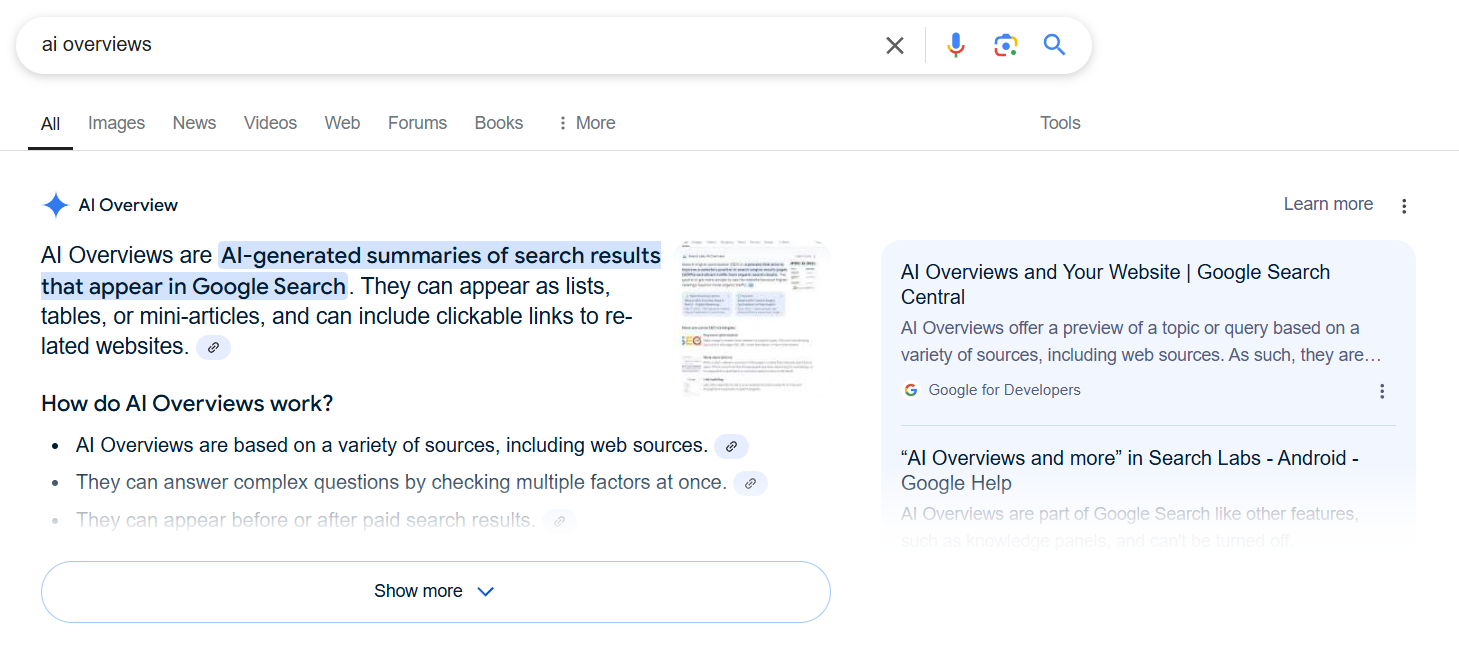
AI overviews are a prime example. They may have gotten off to a shaky start when they were first introduced back in May 2024, but they’re now a prominent feature of Google’s search engine results pages. Just like featured snippets, ‘people also ask’ and widgets like the calculator, this is Google’s way of keeping you on the platform by answering queries without the need to click through to a result.
While it’s useful in some instances, for example when you search for “AI overviews” it’s convenient to see that answer right there at the top of the page, it takes traffic away from the websites that historically would have ranked for those terms. We predicted in 2024 that we would see a rise in traffic erosion and click-through rates as a result, and we expect to see this continue (if not increase) in 2025.
Recent Google AI features
Customer review summaries
Google is showing AI-generated summaries of customer reviews on some top-quality store pages. These are automatically generated from reviews across Google platforms like Maps and product pages, and use AI to condense the key points and sentiment for multiple reviews into one concise overview. The purpose is to allow users to quickly grasp the general consensus without having to read through each individual review.
Backgrounds for Google Business Profiles
Businesses are now able to create AI-generated backgrounds for their Google Business Profile posts. These backgrounds can make posts stand out more, which is useful if you don’t have any design resources in-house.
Google Ads’ image generator
In a similar vein to business profile images, you can also use AI to create realistic images of people and faces for ads, which Google found to drive higher engagement.
AI models as search engines
AI is eroding organic traffic away from the Google SERPS, too. As AI models like GPT and Gemini become a part of our everyday lives, users are naturally becoming more reliant on these tools to conduct searches, whether this be to answer a question, find a recipe, or even plan a trip itinerary (kind of like a virtual assistant). These AI models also do what search engines currently cannot – they provide answers that are tailored exactly to the search query and can be personalised even further by engaging in a “conversation” with the AI. For example, when you search Google for recipe inspiration, you’re essentially being served other people’s recipes that may not meet your dietary needs, or you may not have the exact ingredients to hand. With GPT, you can input the exact items that are in your fridge and ask the AI model to create a recipe using only those ingredients.
Prediction #2: the rise of social search
As AI continues to change the way we interact with search, becoming more and more prominent in the results pages, social search is becoming the go-to for Gen Z and Millennials. Why? Social search generally offers what AI-generated features cannot: unique human perspectives. Platforms like Reddit, TikTok, YouTube and even LinkedIn provide more engaging (and less robotic) content than search engines, so we expect to see a rise in social search this year, with TikTok being used as a primary search engine by younger demographics.
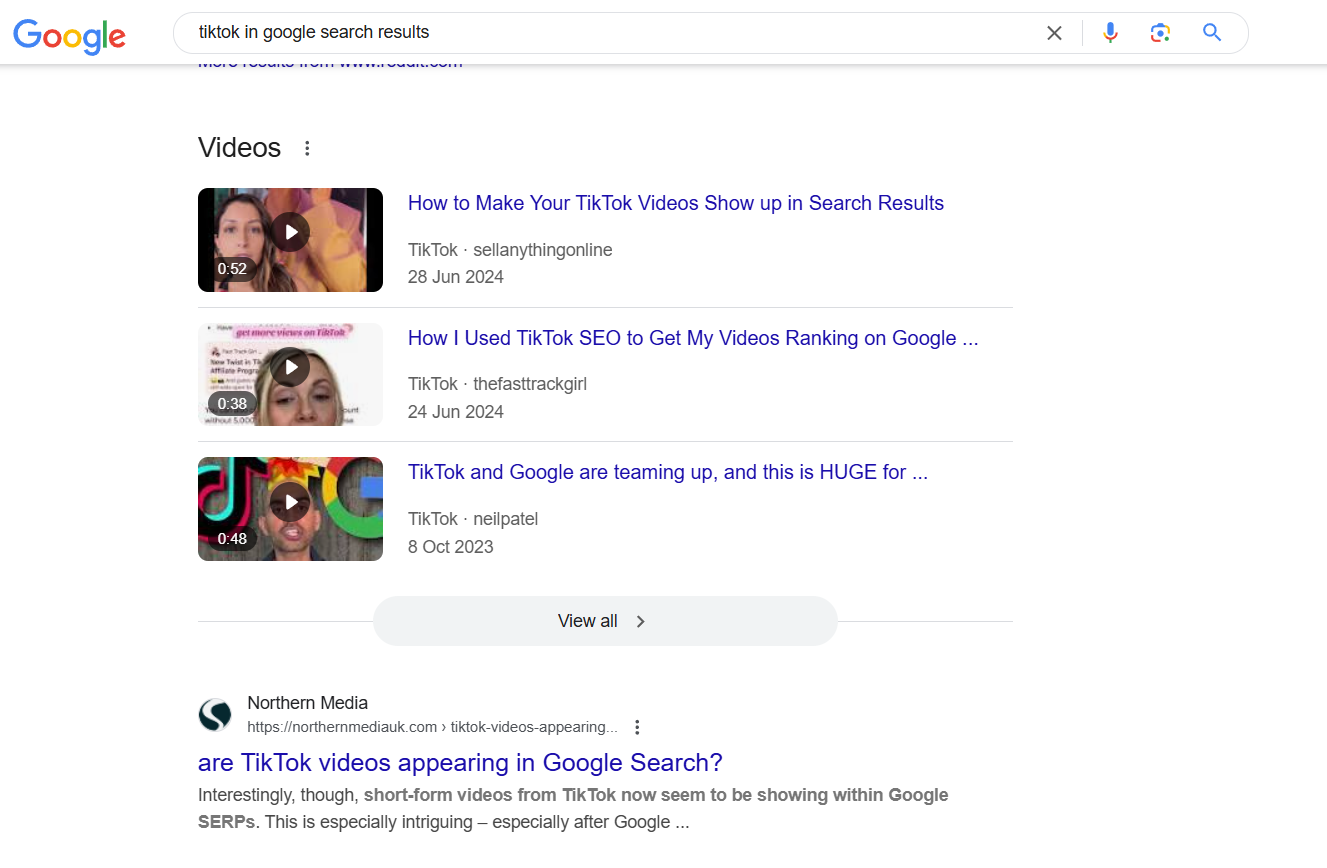
For the past couple of years, TikTok videos have even been showing up in the SERPs in various forms, from featured snippets to SGE. For some searches, TikTok videos actually take more prominent positions in the ‘videos’ section of the results than YouTube, demonstrating that TikTok is a valuable tool in search – and Google knows it.
2025 actions
At the beginning of the year, Google rolled out two new features in search. ‘What people are saying” showcases (mainly video) content from (primarily) social media sites about what’s popular or trending in a location. The feature triggers for searches where you’re gathering information to visit a place.
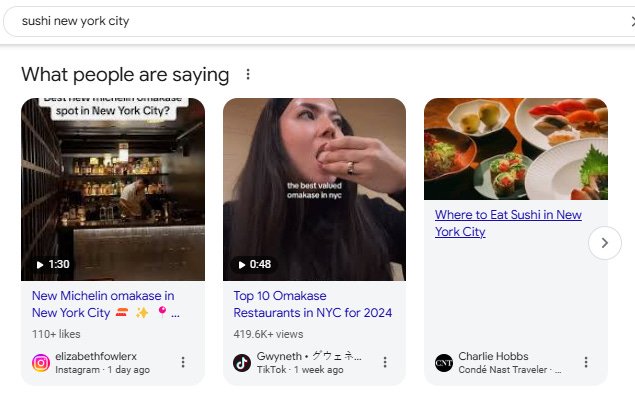
The results are fleeting and seemingly random at times (the first video has 110+ likes while the second has 419K), but it shows Google’s shift in serving rich results within the SERPs. Like the “people also ask” feature, the “things to know” feature could be a good reference when creating content plans.
While it’s in no way a standalone way to create a content plan, it can help you address any gaps in your content briefs and ensure you’re covering what Google expects to see when serving results. You’ll see a “buying guide” feature in the US SEPRs, which can also be used as a reference to ensure you’re covering all angles.
Prediction #3: those who diversify will thrive
So, with more and more users turning to social media platforms for conducting searches and the clear erosion of traffic and clicks, it’s clear that brands can’t put all of their eggs in the Google basket. Brands are advised to diversify their traffic sources by leveraging social platforms like TikTok, Reddit, Instagram newsletters and even push notifications as these are gaining popularity for content discovery.
Plus, a diversified approach makes you less vulnerable to Google’s algorithm updates and can open you up to new audiences.
Prediction #4: E-E-A-T will be more critical than ever
If you’ve been keeping up with Google’s latest core updates, you should be very familiar with the concept of E-E-A-T (experience, expertise, authoritativeness and trustworthiness). With so much emphasis on helpful, user-first content, E-E-A-T principles will become even more critical.
Gone are the days of chasing keywords and begging for backlinks. SEOs will need to build authority and trust by demonstrating expert credentials, first-hand experience and a digital footprint, especially in niches like health and finance.
The age of the AI co-pilot
A greater emphasis on E-E-A-T also means further crackdowns on AI-generated content. While this may sound contradictory to the point above on AI-powered search features, here we’re talking about content creators who rely too heavily on AI, resulting in generic content that sounds robotic, is clearly written for the sole purpose of ranking for a particular keyword, and doesn’t offer much value to the user. Ironically, Bing and Google are happy to push their own AI systems, but we’ve already seen Google cracking down on heavily unedited AI copy (which was summarised in this LinkedIn post).
You can still use AI tools, but to scale, not to write your website content. A human touch should always be maintained to ensure quality and originality. AI is not a replacement, but rather a research assistant or editor.
How to tell human & AI content apart
We’ve all experienced those annoying CAPTCHA tests, where we’ve got to click on a bunch of bicycles before we’re allowed to continue on, but what if Google has similar systems to tell which pages were written by humans?
At Venture Stream, we’ve noticed more and more job applicants submitting AI-generated cover letters, with very little to no editing at all. Here are the common signs that are piece of content has been written by AI:
- Americanisms: despite stating “write in British English”, ChatGPT always seems to prefer using American grammar, more specifically changing “s” to “z”, e.g. optimization or summarize.
- No personal experience: experience is one of the pillars of Google’s EEAT guidelines. AI often lacks personal anecdotes or experiences, which is common in human writing.
- Overly formal/neutral tone: AI tends to use a more formal or neutral tone, avoiding slang, colloquialisms, or strong emotions.
- Factual errors: while AI can be pretty accurate, it can also make factual errors or show inconsistencies in its understanding of complex or nuanced topics.
- Generic or broad responses: AI responses can sometimes be more generic or surface-level, lacking the depth or insight that might come from an experienced human.
2025 actions
With search engines effectively controlling what AI you’ll see, content creators will have to ask the following questions.
Could AI easily write this?
e.g. “How to tie shoes”
If the answer is YES, then ask
Can I add a unique perspective?
Could you broaden the piece? e.g “How to tie Oxford shoes”
Is the content relevant to my niche or could it be adapted to suit?
If you’re just writing only because you’re hoping to rank for a lucrative keyword, it’s probably not going to work.
Would my existing audience click on this content, from my newsletter?
It’s OK if a piece of content doesnt rank for anything. If it gives value to your regular customers or could be used on social media, the content could still help with your overall ranking efforts.
If the answer to these questions is NO, it’s time to move on to something else.
Lastly, ask:
What do the SERPs look like for this kind of content, what kind of results are showing?
If you see a lot of videos ranking for your keywords, then consider embedding a YouTube video within the content.
Prediction #5: big focus on brand
SEO can no longer operate in isolation, and we expect to see SEO fully integrate with brand and marketing strategies. Successful strategies will involve a holistic approach, integrating traditional brand-building, audience understanding, and content personalisation to align with user intent and behaviour.
Building a strong, recognisable brand and demonstrating expertise in a niche will continue to be important for search engines. Google will continue favouring brands and entities it trusts, with topical authority being a crucial differentiator.
2025 actions
Focus on brand first, and place more consideration to where your content and SEO strategy fits within the whole marketing mix (user experience, email, referral traffic, etc). A flat year for organic traffic in 2025 should be viewed as a victory, but this doesn’t mean that organic revenue should be flat, too.
Further 2025 SEO predictions
If you’re interested in finding out more about 2025 SEO trends, we highly recommend the following publications.
Crawling Mondays by Aleyda Solis – SEO Trends, Predictions & Tips for 2025. Predictions from eight powerhouses in SEO – well worth a listen if you don’t have the time to sieve through everything else.
Majestic SEO – This year, they asked 106 leading SEOs to share their number one actionable tips for 2025. https://majestic.com/seo-in-2025
Search Engine Land – Evolving SEO for 2025: What needs to change. “Learn the emerging priorities shaping 2025’s SEO landscape” https://searchengineland.com/evolving-seo-for-2025-what-needs-to-change-450911
For expert, one-on-one help with your SEO and content strategy for 2025 and beyond, send us a message to speak to a member of our organic search team.