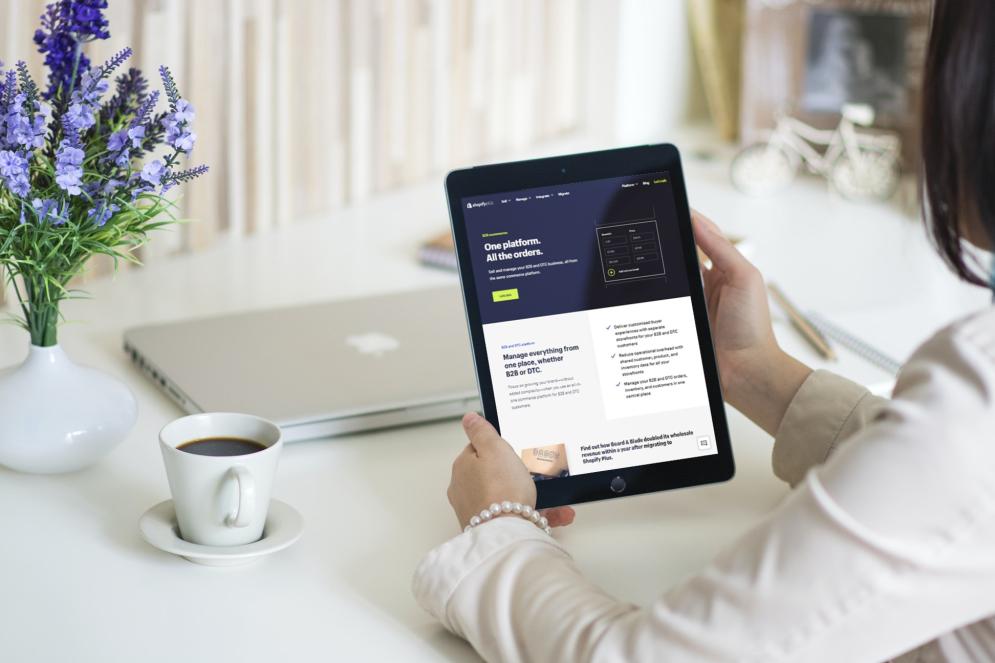
Every business wants to make day-to-day operations as seamless as possible. B2B ecommerce provides a fast and simple way to acquire stock, usually via an online portal.
Wholesaling has undergone somewhat of a revolution over recent years thanks to platforms such as Amazon, Wish and Ali Express. Whilst wholesaling has previously been thought of as an old-fashioned way to shop requiring orders to be taken manually, it’s become a lot more appealing thanks to the rise of user-friendly, self-servicing online platforms.
One of these platforms is Shopify. But many people don’t actually know that Shopify has B2B functionality. If you’re a B2B business looking to replatform and had previously ruled the ecommerce giant out, read on to discover whether Shopify is good for B2B businesses.
Is Shopify suitable for B2B?
First things first – it’s important to note that wholesale and B2B features are only available with Shopify Plus, the platform’s most advanced plan. We’ve previously delved into the Shopify vs Shopify Plus debate, so be sure to check that post out if you’re unfamiliar with the differences between the two.
If your business requires a more advanced platform that can handle approx 10,000 transactions per minute, larger product catalogue etc., then yes, Shopify is absolutely suitable for B2B. If your B2B ecommerce business is on the smaller side or in its infancy, then Shopify isn’t going to be the platform for you right now (though may be worth looking into further down the line).
How to sell wholesale on Shopify
Just as you can create products to sell to regular customers, you can also create products to sell to other businesses in Shopify. The first difference is that you have four options on how to do this. Wholesale marketplaces, wholesale app, a separate, password-protected storefront or a new online store hosted on a subdomain.
1. Join a wholesale marketplace
Using Shopify Marketplace Connect, you can connect your Shopify store with multiple online marketplaces. While Shopify Marketplace Connect isn’t directly designed for B2B sales, it can be used for B2B activities by integrating your store with B2B platforms. In order to facilitate B2B sales, you need to designate customers as “companies” in your Shopify admin. You can then personalise the B2B experience by customising pricing, currency, product availability, payment methods, shipping options and store content for each B2B customer.
2. Use a wholesale app from the Shopify app store
Another way to set up a wholesale store within your existing Shopify account is by installing a wholesale app like Faire or NetWise. These apps allow you to sort customers into tiers, set bulk discounts and order limits, and create exclusive registration forms.
3. A separate, password-protected storefront
If you’d prefer merchants to have to enter a password to use your wholesale store, then you can create a password-protected storefront as an extension of your existing online store. This allows you to offer custom pricing and process wholesale orders within your existing Shopify admin. There are apps such as Locksmith which offer more advanced, customisable features, such as allowing customers to set up their own passwords rather than sharing one generic password.
If you sell both B2B and B2C, we’d recommend opting for the second option to ensure your wholesale store doesn’t disrupt your B2B store.
4. An entirely separate online store
This may sound like a lot of work, but it’s not as difficult as it sounds. Many retailers host the wholesale side of their business on a subdomain. For example, if your main store’s URL is www.examplestore.com, your wholesale store could be at wholesale.examplestore.com. This can be achieved by copying your existing store over to a new one, password-protecting it, then customising it according to your wholesale customers’ needs. It’s worth noting that if you opt for this method, you’ll still need an app to enforce minimum order amounts, or alternatively code a minimum on the cart page.
Shopify B2B features
Shopify’s B2B solution offers some really handy features to help ensure your store is both user friendly and profitable.
Minimum purchase spend
The point of wholesale buying and selling is to purchase larger quantities of stock, as businesses require this to meet customer demand. Shopify’s B2B platform allows you to set minimum spends, meaning if an order does not hit a certain item threshold, the user will not be able to checkout. This helps to ensure your B2B business remains profitable and every sale is worth your while. It also prevents customers from using your B2B store for personal shopping – cost per item is generally up to 50% lower than regular retail price, so the feature is very important.
Minimum purchase fee
The purpose of the minimum purchase fee is pretty much the same as minimum purchase spend. Instead of stopping someone from checking out altogether, you can opt to add a minimum purchase fee to their order. The customer will be alerted that the fee will be added and how much it is when they hit the checkout button, and it will show in their shopping cart alongside selected products.
Volume based discounts
Volume based discounts offer larger savings the more a customer buys. Retailers buying wholesale want to make the biggest profit possible and keep margins healthy, so volume based discounts are a smart way to sell more and keep your wholesale customers coming back.
Personalisation
Building a pool of regular customers is the goal with any retail business, but many wholesalers rely on regular custom, and buyers often don’t want to keep switching suppliers either. Shopify’s personalisation features help you deliver top-class customer service by offering personalised products, pricing and payments.
Custom pages
Create all of the important pages any ecommerce website needs, such as FAQs and policies, using a basic template provided by Shopify.
Customer accounts
As touched on earlier, Shopify offers a customer accounts feature that allows you to show B2B customers your wholesale products and pricing, while keeping your existing product pages for B2C customers. Retailers can log into your store, manage their orders, view past orders and save their account information.
Catalogs
Merchants can create different product catalogs for certain customers based on specific conditions. This is useful for B2B sellers as they can easily customise price lists, offer additional discounts and segment catalogs to show different products to different customers.
Payment terms
Many wholesalers offer net payment terms to allow retailers to pay for items as they make sales, for example, upon fulfillment or by an agreed due date. Shopify allows eight different net payment term options, including net periods, due on receipt, and due on fulfillment. Merchants can also set custom payment due dates.
Why sell wholesale?
Many ecommerce businesses opt to sell wholesale after recognising the advantages it can offer over traditional B2C retail. The majority of brands spend a large sum of money on marketing. When you sell B2B, the buyer has the responsibility of marketing the products and acquiring customers, freeing up your own time and money.
You also don’t have the task of building a loyal audience. Partnering with a successful retailer means they’ve already done the legwork in this area, and you can leverage this to sell your products.
Whilst many retailers have and still continue to ship their stock from China due to lower costs, increased attention on the environmental and ethical impact of purchasing overseas has many people looking for more sustainable ways to shop. Plus, with America’s latest tariff increases resulting in trade wars and boycotts, we may see international B2B businesses may be importing goods from elsewhere, and UK businesses buying local.
Whether you’re a B2C, B2B retailer or both, it’s clear that the Shopify platform has something to offer just about every ecommerce business, making life easier with innovative features and a simple interface.
Thinking of making the move to Shopify Plus? We’re a certified Shopify Plus Partner, so you’re in the right place. Get in touch to discuss your next project.
